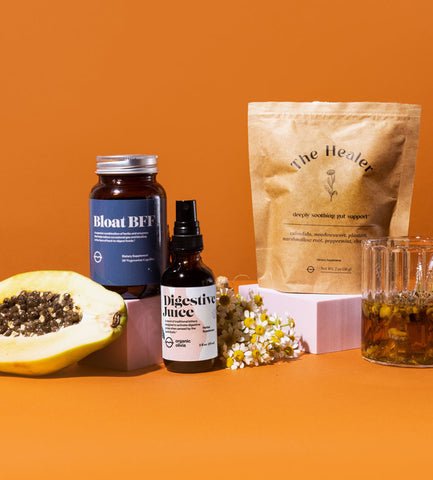

Let’s talk about something none of us want to admit but a shocking number of us are dealing with: not pooping enough. Up to 20% of Americans (that’s 70 million people!!) are chronically constipated and most of them have either normalized it, don’t even realize it qualifies as constipation, or have been told there’s nothing to do about it except eat more fiber.
The truth is, you shouldn’t be struggling to have a bowel movement daily, be sitting on the toilet for long periods of time, or feel uncomfortable afterwards. If that’s not your current reality, keep on reading!
We’ll cover what constipation is, how to know if yours is chronic, the real root causes, lifestyle shifts that genuinely help, and targeted herbal support (like probiotics, liver herbs, and plant-based minerals) that addresses the underlying issue, not just the symptom.
What Constipation Looks Like
The clinical definition of constipation is passing fewer than three bowel movements per week, but that’s setting the bar suuuuper low. Functional medicine considers one or more daily bowel movements to be the baseline. Some signs you might be more constipated than you realize are:
-
Fewer than one bowel movement per day
-
Straining to go
-
Hard, dry, or pellet-like stools (types 1-2 on the Bristol Stool Chart)
-
Feeling like you never fully evacuate
-
Spending a long time on the toilet with little success
-
Bloating and abdominal discomfort (that tends to get worse throughout the day)

And listen, occasional constipation is totally normal. Sometimes travel, stress, or a weekend of eating outside of your norm can throw off your digestion temporarily. We’re talking about chronic constipation here. The kind that persists for weeks or months, keeps returning, or requires constant laxative use to manage. This is almost always rooted in something systemic, and it rarely resolves with surface-level fixes.
Why You’re Backed Up
1. Not enough fiber (or not the right kind).
We know, we know. But fiber genuinely matters! Let’s quickly review the two types of fiber and why they both have important roles in our bodies. Soluble fiber dissolves in water to form a gel-like substance that slows down your digestion, feeds beneficial bacteria, and adds bulk to your stool to make it easier to pass. The kind of fiber is found in foods like oats, chia seeds, legumes, apples, and pears. Soluble fiber, on the other hand, doesn’t dissolve in water. It simply adds roughage to your stool and speeds up intestinal transit time, essentially sweeping food through. These are your fibrous, stringy veggies and more dense foods like whole grains, vegetables, and nuts. While most Americans are seriously underconsuming both types, soluble fiber is usually the one that gets most neglected. Aim for 25-35g of fiber per day, but if you’re far from that currently, be sure to increase fiber SLOWLY and pair every increase with additional water.
Tip: add 1-2 tbsp of ground flax or chia to your breakfast.
2. Dehydration
One of your colon’s jobs is to absorb water from everything that passes through it. When you’re chronically dehydrated, it absorbs more water from your stool, causing it to be harder, drier, and way more difficult (and uncomfortable) to pass. It sounds almost too simple, but chronic dehydration is genuinely one of the most common (and most fixable) drivers of constipation. The eight glasses a day guideline is a starting point, but your real needs depend on where you live (Is it hot? Are you at altitude?), your activity level, your body size, your diet, and any medications or supplements you’re taking. The most practical benchmark is ensuring you’re pee is pale yellow – not clear, not dark.
Tip: drink 8-16 oz of water with a pinch of salt and/or a squeeze of lemon before your morning coffee. You can slug it down while your coffee is brewing!
3. Gut dysbiosis
The trillions of bacteria, fungi, and other microorganisms living in your gut play a direct role in regulating your motility. Certain beneficial bacterial strains produce short-chain fatty acids (by eating fiber!) that stimulate intestinal contractions and keep things moving. When that ecosystem is imbalanced (from too few beneficial species or too many pathogenic species), motility slows down. And simply adding more fiber and water won’t fix it if you’re not also addressing WHY you’re microbiome is off in the first place.
Tip: take a comprehensive probiotic before bed and see if you notice a shift. If you have a history of SIBO, opt for a spore-based probiotic like Bloat BFF instead.
An advanced prebiotic, probiotic, enzyme blend designed to support gut microbiome diversity, skin health, digestion and elimination.* STAR HERB: Lactobacillus rhamnosus GG.
Not Your Average Probiotic
5. Chronic stress
Your gut and brain are constantly communicating via the vagus nerve – a two-way highway that connects the two organs. When you’re chronically stressed, your nervous system gets stuck in sympathetic mode (fight or flight), which actively suppresses digestive function. Your body is too busy preparing to run or fight to bother digesting your lunch. Therefore, peristalsis (the wave-like smooth muscle contractions that move waste through your GI tract) slows, digestive enzyme production drops, and blood flow gets shunted away from your gut entirely. This is exactly why digestion tends to go sideways during stressful seasons. It’s literally biology. Chronic stress also depletes key electrolytes like magnesium that are essential for healthy digestive function.
Tip: activate your vagus nerve before meals with 5 slow, deep belly breaths, humming, or chanting. It shifts your nervous system into parasympathetic, or rest and digest, mode.
6. Not enough movement
Physical movement stimulates peristalsis. Full stop. So you can see why long stretches of sitting (hello travel and desk jobs) can slow down motility pretty significantly. But the good news is that you really don’t need intense exercise to get your bowels moving. Even just a 10+ minute walk after meals can meaningfully speed up gastric emptying and transit time. So can twisty, gooey stretching sessions or yoga flows.
Tip: walk for 15+ minutes after two of your meals today.
7. Hormonal imbalances
Do you notice your digestion shifts throughout your cycle? There’s a very real reason for this. As progesterone takes over in the luteal phase (the second half) of your cycle, motility slows down, and constipation may creep in. Women with progesterone dominance or low estrogen (common in perimenopause and menopause) often deal with this chronically. Hypothyroidism is another big one. Because thyroid hormones regulate gut motility, low thyroid function often shows up as sluggish digestion before anything else. If nothing seems to be helping your constipation, it’s worth running a full hormone and thyroid panel to check your levels.
Tip: lean on Liver Juice and/or Flow Balance to support healthy liver function and hormone balance, especially if you’re noticing swings throughout the month.
8. Mineral deficiencies
This one is a seriously under-discussed root cause of constipation, and one that mineral-based practitioners like Amanda Montalvo have been spotlighting for years. As she puts it, minerals are the spark plugs of your entire body, including your digestive system. Thus, a depleted mineral status almost always leads to suboptimal digestion, no matter how much fiber you eat.
Some of the most critical minerals for digestion are magnesium, sodium, potassium, and zinc. As we mentioned earlier, magnesium plays a major role in smooth muscle function, including the muscles that line your intestinal walls. Sodium and potassium have a direct relationship, working together to regulate fluid balance in your cells. Without them, your colon can’t maintain the hydration needed to keep stool soft and moving along. This is why plain water sometimes doesn’t cut it if your cells are thirsty for minerals. Lastly, zinc is required to produce stomach acid in the first place! So low zinc reserves = low stomach acid = poor mineral absorption = sluggish motility. Low stomach acid also means the entire downstream digestive cascade (enzymes, bile flow, motility) never properly gets triggered.
Tip: add plant-based minerals to your water or supplement with beef liver for bioavailable minerals your body knows how to use.
A revitalizing herbal mineral tincture for an extra boost of hydration and energy.* STAR HERB: Nettle
Mineral Boost
9. Medications and supplements
Attention all iron-taking women out there: iron supplements are notorious for causing constipation. Double-check what form of iron you’re supplementing with, and consider switching to a more gentle form if you’re feeling backed up. Other common culprits include pain medications, antacids, certain antihistamines, and high-dose calcium supplements. If your constipation started around the same time as a new medication or supplement, try bringing in some of the food and lifestyle recommendations in the next sections to see if that improves anything.
Foods that Help Motility
-
Kiwis (eating two a day is shown to significantly improve constipation in clinical trials, thanks to the enzyme actinidin)
-
Prunes and prune juice
-
Ground flax and chia seeds
-
Legumes
-
Roasted root vegetables
-
Oatmeal
-
Warm liquids
-
Ginger
-
Pears and apples (bonus points if they’re stewed or cooked)
Simple Lifestyle Shifts That Make a Big Difference
Proper hydration: Drink water throughout the day and be sure to add minerals to your water! Even just a pinch of high-quality sea salt is really helpful.
Movement: Commit to some form of consistent daily movement, whether it’s walking, pilates, strength training, dancing, yoga, swimming… whatever you genuinely enjoy doing because that’s what you’re going to stick with. Abdominal massage can also work wonders for chronic constipation.
Toilet posture: Think about it, our bodies are designed to squat while pooping. Sitting on the toilet creates a kink in your colon that makes complete elimination much harder. Investing in a squatty potty or some kind of elevated footstool straightens the angle and makes it more like a squatting position. This is fantastic if you find yourself straining or struggling to get everything out.
Nervous system support: Activate your vagus nerve and parasympathetic nervous system state with:
-
Diaphragmatic breathing (deep belly breathing)
-
Humming, gargling, chanting, singing
-
Cold exposure (splashing cold water on your face, taking a cold shower, using an ice pack)
-
Meditating
-
Shaking your body out
-
Walking
-
Legs up the wall