
Carson Meyer is a doula, certified nutrition consultant, author, and founder of C & The Moon, a clean skincare line rooted in ritual and nourishment. She has supported hundreds of women on their path to parenthood through postpartum care, family circles, and doula mentorship. Her work has been featured in Elle, Vogue, GOOP, and the Los Angeles Times. A graduate of NYU’s Gallatin School, she lives in western North Carolina with her husband, daughter, and Bernedoodle, Paulie.
Her Skincare Line: C & The Moon
We asked Carson to share her perspective on why the postpartum season deserves more reverence, nourishment, and support, and what new mothers need during the early weeks and months.
You’ve supported so many mothers through the postpartum period. Why do you think postpartum is often overlooked in our culture, and why does it deserve more attention than it receives?
There are a few important factors that inform how we approach postpartum care in our culture. One is that many of our mothers and grandmothers didn’t receive intentional postpartum support themselves, which leaves us without the generational traditions, rituals, and frameworks that exist in other cultures. Because of that, our support systems often don’t have the tools or language for how show up for a new mother. It’s then up to us to ask for what we need and to actively bring these pillars of support back into our culture so they can one day become the norm for our daughters.
We also see the disregard for postpartum care reflected systemically, especially in the lack of maternity leave for the vast majority of women. There’s an expectation that mothers should “do it all” immediately, and financial pressure absolutely shapes how postpartum is experienced as well. That early, sacred window after birth is a crucial opportunity for a mother to heal physically, replenish herself, and create a container for the family to emotionally integrate one of life's greatest transitions. When we rush or ignore that window, it has a ripple effect far beyond the postpartum period itself.
What are some early signs you see that a mother may be under-nourished, even if everything appears “fine” on the outside?
An under-nourished and under-supported mother is more likely to experience postpartum depression or anxiety, low milk supply, and ongoing breastfeeding challenges. These issues are often times normalized or brushed off, but they’re meaningful signals that the body and nervous system need more care, nourishment, and rest.
For mothers who feel guilt or resistance around asking for help, what do you want them to hear right now?
Asking for help can bring up so much vulnerability and emotion. It’s important to remember that this season of life was never meant to be experienced alone or in isolation. The people who love you often want to help; they just may not know how. When we ask for support and give our loved ones specific roles, we begin re-weaving community and family back into a culture that’s deeply lacking in this area. Most importantly, we’re modeling something powerful for our children: how to seek support to grow into the most collaborative and well-resourced human beings.
What’s your favorite herbal infusion and/or hydrating beverage for postpartum mothers?
I love Jujubee tea postpartum! It is rich in Vitamin C, which, of course, is great for the immune system but also helps with collagen synthesis to support skin elasticity. We add ginger and goji berries to it, making it naturally sweet, deeply nourishing, and incredibly comforting.
If you had to simplify postpartum nourishment into 3 non-negotiables, what would they be?
In my book, I actually outline four non-negotiable pillars for a harmonious postpartum: support, proper nourishment, rest, and touch.
When it comes to nourishment specifically, my top three priorities are:
-
Plenty of calories and frequent snacking (this is not the time for restriction or dieting).
-
Iron-rich animal protein to support recovery, blood building, and energy.
-
Healthy fats, which are essential for hormone balance, brain health, and sustained nourishment.
You’re currently pregnant with your second and close to meeting your baby. How has your understanding of postpartum evolved since your first birth?
In many ways, not much has changed, but my expectations have softened. I know this postpartum will look different as a toddler mom, and I’m trying to prepare both my daughter and myself by focusing on patience and grace. I plan to take meaningful time off work and will again have the support of a postpartum doula who provides me with bodywork and nourishing meals. That said, I also know that tending to two small kiddos will bring moments that are far less quiet and predictable!
Many Organic Olivia formulas focus on nervous system support and replenishment. Which feels most aligned with the postpartum season, in your experience?
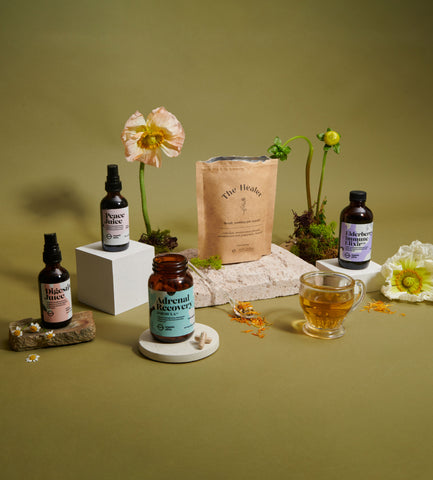
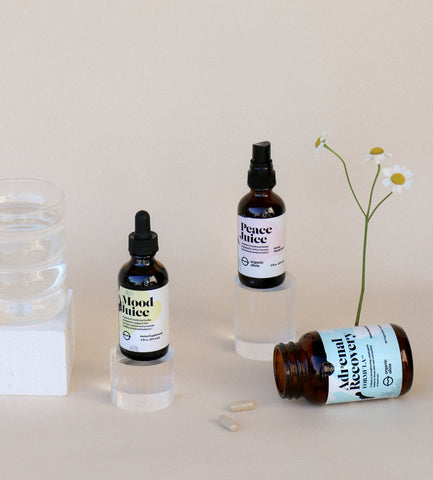
You guys have so many wonderful blends! I would say that the Adrenal Recovery blend is probably one of my favorites for postpartum. Adaptogens can be such a game-changer if a mother is navigating sleep deprivation, mental fog, or mood changes as a new parent. And on a family note, I give my three-year-old Elderberry Elixir every day in the winter months to keep the germs at bay!
A strengthening blend of adaptogens to help combat occasional stress in those who feel frazzled or overworked.* STAR HERB: Ashwagandha
Adrenal Recovery