
You’ve heard about the crucial relationship between your gut and your brain, yeah? A big part of that connection comes down to a single, incredibly powerful nerve that runs between the two. The vagus nerve is the main line of communication between your brain, heart, lungs, and (ultimately) gut. It’s constantly sending messages back and forth about what’s happening inside of you and around you. When it’s functioning optimally, your body knows how to rest, digest, heal, and soften. You feel more grounded in yourself, your digestion flows, and your breath deepens. Yet when the vagus nerve is strained, your system can feel stuck in survival mode – even if nothing is technically “wrong” per se. The best part about supporting vagal tone is that many of the most effective strategies are wildly simple human functions, like breathing, singing, and moving.
The Role of the Vagus Nerve
This critical nerve is the longest cranial nerve in your body, starting in the brainstem and wandering (the Latin word vagus literally means wandering!) down through your organs and into your digestive tract. It’s the backbone of your parasympathetic nervous system, aka the rest and digest side of your stress response. While we often think of stress as something that lives in the mind, our bodies experience stress physiologically. You can probably quite easily recount a moment where your heart rate spiked, breath shortened, blood flow shifted, and digestion slowed down. Your vagus nerve helped orchestrate all of this!
When your vagus nerve is functioning properly, you’ll notice:
-
A lower resting heart rate
-
Better digestion and gut motility
-
Reduced inflammation
-
A more resilient stress response (and immune system)
-
Improved mood and emotional regulation
Researchers use the term “vagal tone” to measure how responsive and flexible the vagus nerve is. So, higher vagal tone is linked with these qualities.
Signs Your Nervous System is Craving Safety
-
Anxiety, panic, or hypervigilance
-
Feeling on edge when there’s no reason to
-
Poor digestion
-
Shallow breathing, chronic hyperventilation, or a tight chest
-
Poor sleep or trouble winding down
-
Emotional reactivity
-
Fatigue that rest can’t seem to touch
How to Stimulate Your Vagus Nerve
There’s no single hack or quick fix for improving vagal tone. Instead, it’s about inviting your system back into balance through small, embodied practices that signal safety to your mind and body. These work because your vagus nerve innervates your throat, diaphragm, heart, and gut, so anything that engages these areas/organs can help tone it.

Diaphragmatic breathing – Take long, slow breaths, inhaling for 4 seconds, and exhaling for 6-8 seconds. The extended exhale is the key here. It activates your parasympathetic nervous system by increasing vagal efferent activity. Slow breathing also improves your heart rate variability (HRV), which is a core marker of vagal tone.
Humming, singing, chanting – The vibration created by using your vocal cords mechanically stimulates your vagus nerve, where it passes through your larynx and pharynx in your throat. This is why practices like chanting have been used for centuries in spiritual and healing traditions.
Gargling – The act of gargling strongly activates the muscles in the back of your throat that are innervated by branches of your vagus nerve. Thus, every time you gargle, you’re sort of working out these muscles and improving vagal tone. Over time, your vagus nerve gets more responsive, and you’re able to shift into rest and digest mode more effectively.
Cold – Dunking your face in ice water, placing an ice pack on the back of your neck, ending a shower with a cold blast, or taking a quick cold plunge all activate the diving reflex. This reflex slows your heart rate and stimulates your vagus nerve, rapidly increasing parasympathetic activity. This is why it’s one of the fastest ways to interrupt stress spirals or panic.
Self-massage – Gentle touch along your neck, chest, and belly stimulates mechanoreceptors that communicate directly with your vagus nerve. Even more simply, touch is a biological signal of security, telling your body that connection is present and stress is low.
Laughter – Laughing naturally deepens your breath, engages your diaphragm, and activates engagement pathways controlled by your vagus nerve. A few deep belly laughs is truly a full body parasympathetic reset.
Slow, mindful eating – The vagus nerve plays a massive role in digestion, controlling stomach acid secretion, enzyme release, and gut motility. Eating quickly, on the go, or when stressed blunts these signals. But slowing down, chewing thoroughly, and taking an intentional pause before eating activates vagal pathways that tell your digestive system that it’s safe to receive nourishment.
Meditation – Anchoring attention in your breath and body increases parasympathetic dominance, resulting in higher vagal tone over time.
Herbs to Improve Vagal Tone
The coolest thing about many herbs is that they work gently and holistically on the entire system. For instance, nervine herbs support mood, digestion, inflammation, and stress physiology ALL at the same time. Some of our favorite nervous system allies include:
Milky oats: Deeply nourishing for frazzled nerves. Ideal for burnout, emotional depletion, and chronic stress.
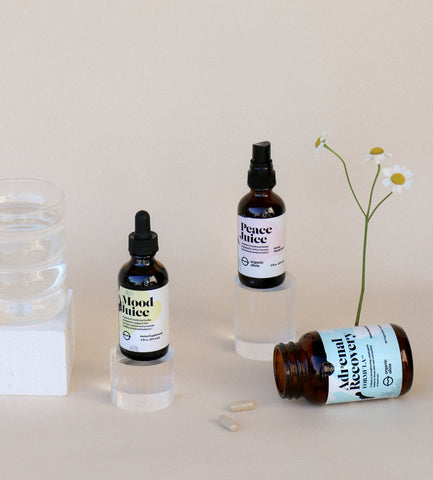
Lemon balm: Brightening and uplifting. Calms anxious energy that lives in the body. You can fine Lemon Balm in our Mood Juice formula that works to support emotional well-being and a positive outlook.
A nourishing mood support formula for maintaining emotional well-being and a positive outlook. STAR HERB: St. John's Wort
Mood Juice
Skullcap: For the mind that won’t turn off and the body that’s holding tightly. It settles racing thoughts and unwinds that tired-but-wired tension. This herb is perfect for those of us that identify with being Type-A. You can find it in Perfectionist Drops.
A calming nervine tincture designed for the high-achieving, overthinking, Type-A brain that holds it all together — until the tension hits your jaw, neck, and nervous system. STAR HERB: Blue Vervain 
Perfectionist Drops
Passionflower: A classic for looping thoughts and nighttime anxiety. It helps the nervous system release its grip and make space for deeper rest.
Chamomile: Soothing, antispasmodic, and calming. Ideal for stress that shows up in the gut as cramps, knots, or digestive discomfort.
Tulsi: An adaptogen for the soul. It builds resilience to stress over time, helping your system stay steady in the face of life’s pressures.
Motherwort: For stress that hangs around the heart chakra. Eases nervous palpitations or that “my heart is racing and I can’t calm down” feeling.
Kava: Practically made for acute nervous system activation. It relaxes muscle tension and gently sedates without dulling the mind.
Lavender: Aromatic and grounding. This classic nervine calms through scent and physiology alike, lowering sympathetic activation.